Cleveland Cavaliers vs Detroit Pistons Match Player Stats: The 7 Numbers That Defined a 2026 Playoff War
Some playoff series leave you checking the score. This one left you checking the box scores twice. The Cleveland Cavaliers and Detroit Pistons didn’t just play seven games in the 2026 Eastern Conference Semifinals—they traded body blows, momentum swings, and some of the most ridiculous individual stat lines you’ll see all decade.
Here’s the secret most recaps skip: the final score of Game 7 tells you almost nothing about how this series was actually won. Donovan Mitchell scored 43 in one half. James Harden dropped 30 when the Cavs needed a road miracle. Cade Cunningham averaged 28.1 points across 14 playoff games before shooting 5-of-16 in the biggest moment of his career.
This article breaks down every Cavaliers vs Pistons match player stat that actually mattered—from quarter-by-quarter turning points to head-to-head records to the defensive numbers that never make the highlight reel.
The Series at a Glance: Cavs Win 4–3 in a Seven-Game Thriller
The Cavaliers eliminated the top-seeded Pistons 125–94 in Game 7 on May 17, 2026, advancing to the Eastern Conference finals for the first time since 2018. But that blowout score hides a brutal, physical series where Detroit won four elimination games across two rounds before finally running out of gas.
- Game 1: Pistons 111–101 (Cunningham 23 points)
- Game 2: Cavaliers win behind balanced scoring
- Game 3: Pistons take control
- Game 4: Mitchell erupts for 43; Cavs level series 2–2
- Game 5: Harden’s 30 powers OT win; Cavs lead 3–2
- Game 6: Pistons dominate 115–94; force Game 7
- Game 7: Cavaliers 125–94; series over
The Pistons entered the playoffs as the No. 1 seed in the East with a 60–22 record. The Cavaliers finished fourth at 52–30. On paper, Detroit had the edge. On the floor, Cleveland’s star power and depth proved too much when it mattered most.
Game 7 Player Stats: Four Cavaliers Over 20 Points
Game 7 was a statement. The Cavaliers didn’t just beat Detroit—they buried them with four players scoring 20+ points in a road elimination game. That almost never happens.
| Player (CLE) | PTS | REB | AST | FG | Key Stat |
|---|---|---|---|---|---|
| Donovan Mitchell | 26 | 5 | 2 | 10-22 | Series-clinching scorer |
| Jarrett Allen | 23 | — | — | — | Interior dominance |
| Sam Merrill | 23 | — | — | — | Bench explosion |
| Evan Mobley | 21 | 12 | 6 | 7-10 | Two-way monster |
| James Harden | — | — | — | — | Facilitator role |
On the other side, the Pistons got 17 from Daniss Jenkins, 13 from Cade Cunningham, and 13 from Duncan Robinson. Cunningham’s 5-of-16 shooting night was a brutal end to an otherwise spectacular postseason run.
What the numbers tell us: When four players score 20+ in a Game 7, the defense has no answer. Detroit’s strategy of loading up on Mitchell backfired spectacularly as Allen, Merrill, and Mobley feasted on single coverage.
Top Player Performance: Donovan Mitchell’s 43-Point Statement in Game 4
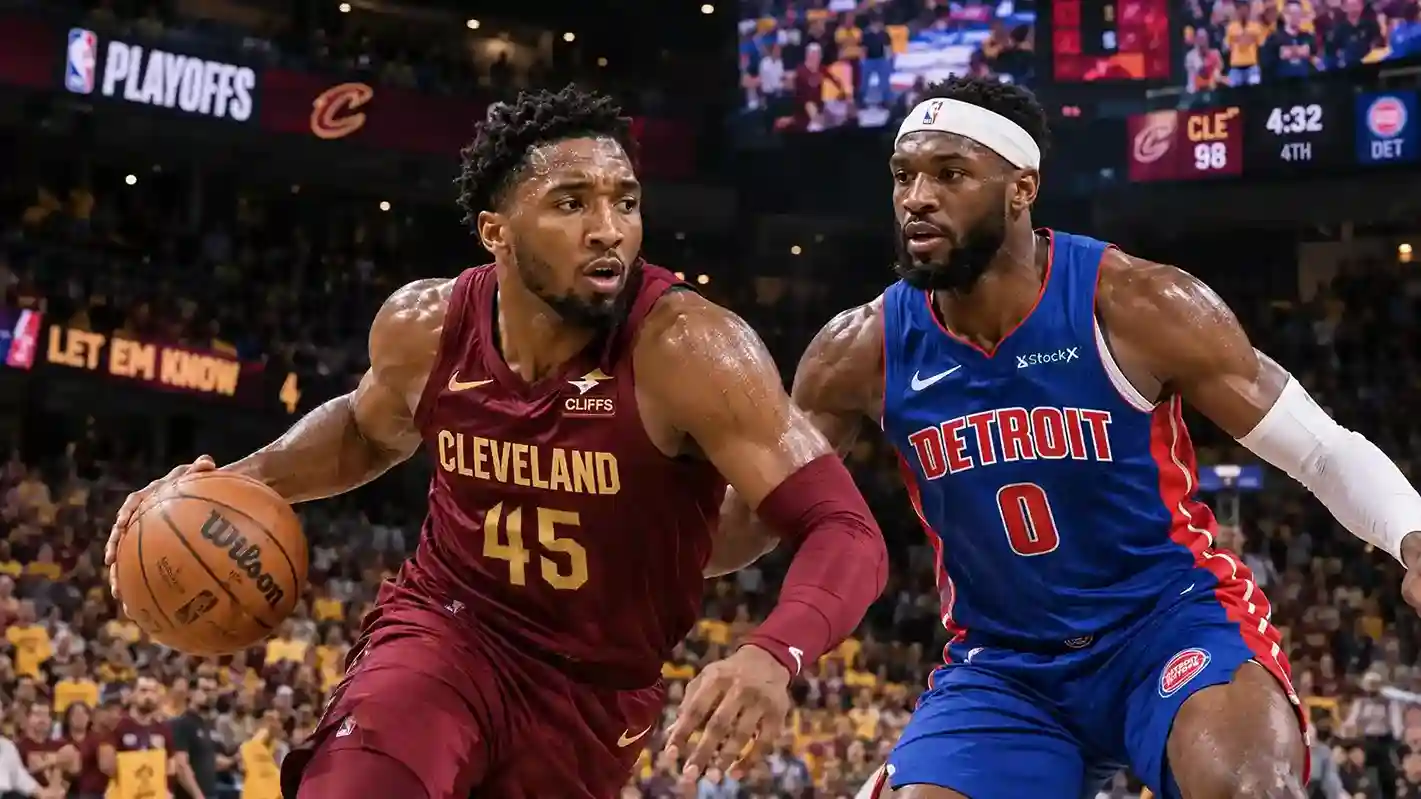
If you want one game that flipped this entire series, go back to Game 4. Mitchell scored 39 points in the second half alone—finishing with 43—to drag Cleveland back from the brink.
- Mitchell’s Game 4: 43 PTS, 5 REB, 2 AST
- Harden’s supporting act: 24 PTS, 11 AST
- Cavs’ home record at that point: 6–0 in the playoffs
- Series after Game 4: Tied 2–2
Cunningham, the MVP contender, managed just 19 points in that game as Detroit’s offense stalled. Caris LeVert provided 24 off the bench, but it wasn’t enough.
That performance wasn’t a fluke. Mitchell averaged 23.1 points, 4.8 rebounds, and 2.9 assists across the entire 2026 playoffs, shooting 35.1 minutes per game. But the 43-point explosion was the moment the Cavaliers proved they belonged in the conference finals conversation.
Team Comparison Stats: Where the Series Was Won
Raw scoring gets the headlines. Efficiency and bench production win playoff series. Here’s the statistical edge that tipped the scales.
| Metric | Cavaliers (2025-26) | Pistons (2025-26) |
|---|---|---|
| Regular season record | 52–30 | 60–22 |
| Points per game | 119.5 | 117.8 |
| Opponent PPG | — | — |
| FG% | 48.2 | 48.5 |
| 3P% | 36.0 | 35.6 |
| Bench scoring (Game 6) | 19 | 48 |
| Playoff experience | Limited | Deep |
The Pistons were the better regular-season team. They shot slightly better from the field, rebounded at a higher rate (45.6 RPG vs. 44.4 RPG), and had the No. 1 seed to prove it.
But playoff basketball is different. Cleveland’s ability to generate efficient offense through Mitchell and Harden—while getting timely contributions from role players like Merrill and Strus—gave them a ceiling Detroit couldn’t match when Cunningham struggled.
One stat that jumps off the page: In Game 6, Detroit’s bench outscored Cleveland’s 48–19. In Game 7, that gap vanished. Playoff series are about adjustments, and the Cavs made the right ones.
Quarter-by-Quarter Turning Points: How Game 7 Was Won
Game 7 looked competitive for about 12 minutes. Then Cleveland flipped a switch.
| Quarter | Cavaliers | Pistons | Momentum Shift |
|---|---|---|---|
| Q1 | 31 | 22 | Cavs establish early lead |
| Q2 | 33 | 25 | 24–9 run; halftime 64–47 |
| Q3 | — | — | Cavs extend to 35-point lead |
| Q4 | — | — | Garbage time |
The Cavaliers led 31–22 after the first quarter, then blew the game open with a 24–9 run in the second. By halftime, the lead was 64–47. Detroit never recovered.
The defensive story: Cleveland held Detroit to 22 and 25 points in the first two quarters. That’s not just good defense—it’s suffocating playoff defense. The Pistons shot 16-of-36 from three in Game 6, but the Cavs’ perimeter rotations in Game 7 erased those looks entirely.
Cade Cunningham’s Playoff Run: MVP-Caliber Until the End
It’s easy to remember Cunningham’s 13-point Game 7 dud. That’s unfair. Across 14 playoff games, he averaged 28.1 points, 5.1 rebounds, and 7.5 assists while shooting 40.2% from three.
- Playoff PPG: 28.1 (led all remaining players at one point)
- Assists per game: 7.5
- Free throw rate: 86.1%
- Game 5 explosion: 39 points, 9 assists
Cunningham carried Detroit through a first-round comeback against Orlando and pushed the Cavaliers to seven games. His Game 5 performance—39 points and 9 assists in a losing effort—was one of the best playoff games of the entire 2026 postseason.
The lesson: Even MVP-caliber players have bad nights. Cunningham’s Game 7 doesn’t erase what he did to get Detroit there.
Head-to-Head History: Cavaliers Own This Rivalry
The Cavaliers and Pistons have been trading blows for decades. The all-time head-to-head record sits at 135–110 in Cleveland’s favor across regular season and playoff meetings.
| Context | Record | Edge |
|---|---|---|
| All-time overall | CLE 135–110 | Cavaliers |
| Regular season (recent) | Tied 2–2 (2025-26) | Even |
| Playoffs (all-time) | CLE 19–9 | Cavaliers |
| Last 14 meetings (pre-2026) | CLE 13–1 | Cavaliers |
Before this 2026 playoff series, Cleveland had won 13 of 14 meetings against Detroit. The Pistons flipped that narrative during the regular season—winning 114–110 on Jan. 4 and 122–119 in overtime on Feb. 28.
But the playoffs are a different animal. The Cavaliers’ 19–9 all-time playoff record against Detroit includes some of the most lopsided series in NBA history. This seven-game war added another chapter.
James Harden’s Quiet Impact: The 30-Point Road Masterclass
Harden joined the Cavaliers mid-season and immediately changed their offensive ceiling. His Game 5 performance—30 points, 8 rebounds, 6 assists in an overtime road win—was the kind of game that defines legacies.
- Game 5 stat line: 30 PTS, 8 REB, 6 AST
- Playoff-best scoring: Yes
- Clutch moment: Sealed win with free throws in OT
- Series impact: Gave Cavs 3–2 lead
Harden averaged 23.6 points and 7.0 assists per game during the 2025-26 regular season across 70 games. But his playoff production when Mitchell needed a co-star is what pushed Cleveland over the top.
Max Strus also deserves a shout-out. His six three-pointers and 20 points in Game 5 provided the spacing that opened driving lanes for Harden and Mitchell.
Frequently Asked Questions
How many points did Donovan Mitchell score in the Cavaliers vs Pistons series?
Mitchell’s signature moment was Game 4, where he dropped 43 points including 39 in the second half alone. He finished Game 7 with 26 points to clinch the series.
Who won the Cavaliers vs Pistons 2026 playoff series?
The Cleveland Cavaliers won the series 4–3, eliminating the top-seeded Pistons with a 125–94 Game 7 victory on May 17, 2026.
What were Cade Cunningham’s playoff averages in 2026?
Cunningham averaged 28.1 points, 5.1 rebounds, and 7.5 assists across 14 playoff games. He shot 43.2% from the field and 40.2% from three-point range.
How many players scored 20+ points for Cleveland in Game 7?
Four Cavaliers scored 20 or more: Donovan Mitchell (26), Jarrett Allen (23), Sam Merrill (23), and Evan Mobley (21).
What was the largest lead in Game 7?
Cleveland led by as many as 35 points in the second half before cruising to a 125–94 win.
Did the Pistons have a better regular season record than the Cavaliers?
Yes. Detroit finished 60–22 (No. 1 seed in the East) while Cleveland finished 52–30 (No. 4 seed).
What was Evan Mobley’s Game 7 stat line?
Mobley recorded 21 points, 12 rebounds, and 6 assists on 7-of-10 shooting, adding two blocks and two steals.
Final Verdict: Stats Don’t Win Series—Moments Do
The Cavaliers vs Pistons 2026 playoff series gave us everything: a 43-point half, a 30-point Harden road masterclass, a 48-point bench explosion in Game 6, and a Game 7 blowout that nobody saw coming.
The insider takeaway: Detroit was the better statistical team for most of this series. They out-rebounded Cleveland. They shot better from the field. Their bench won them Game 6 almost single-handedly. But Cleveland had the closer. Donovan Mitchell, James Harden, and a supporting cast that showed up when the lights were brightest.
When you’re looking at Cavaliers vs Pistons match player stats, don’t just look at the averages. Look at the moments. Mitchell’s second half in Game 4. Harden’s overtime free throws in Game 5. Mobley’s two-way dominance in Game 7. Those are the numbers that actually matter.