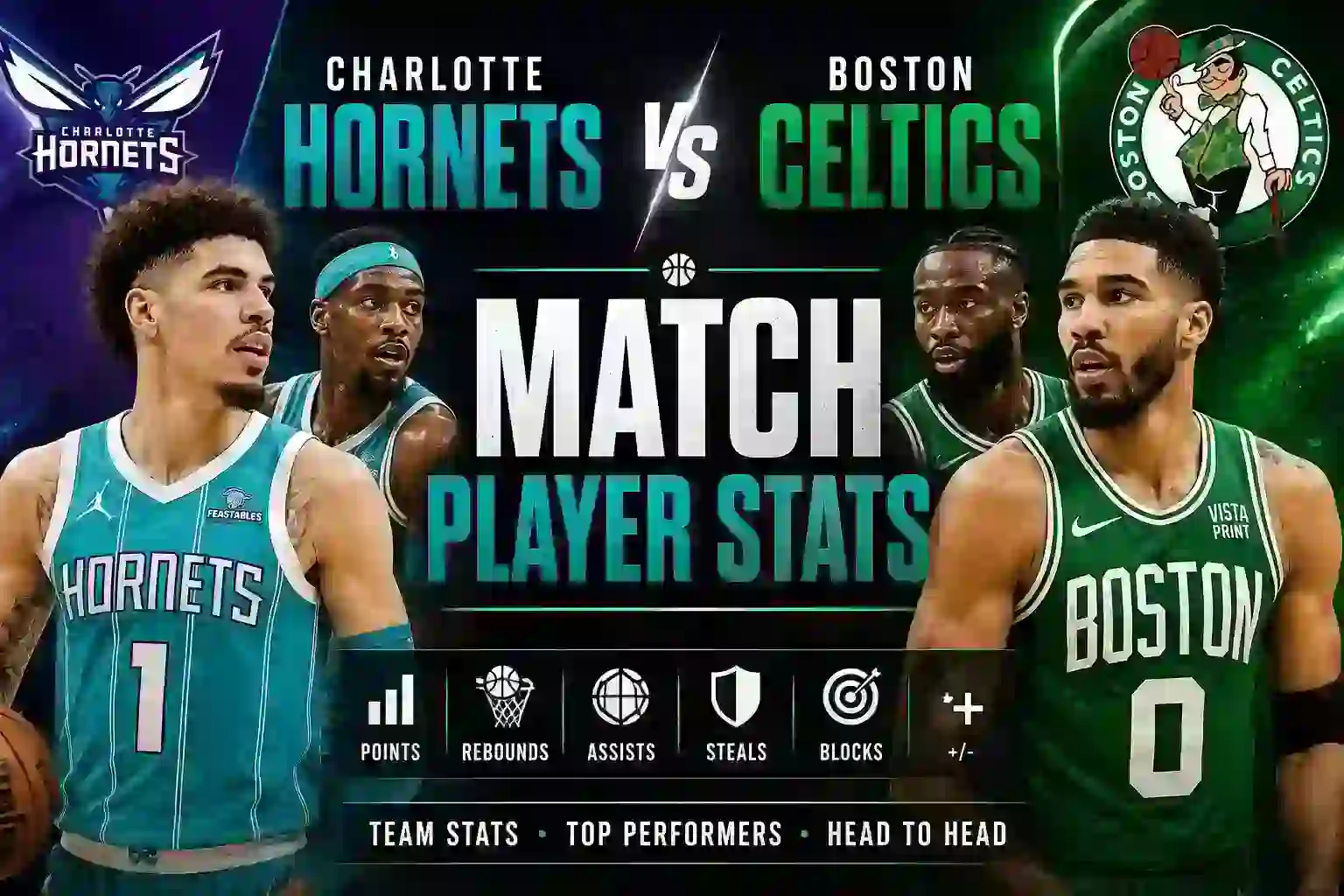
Charlotte Hornets vs Celtics Match Player Stats: Jaylen Brown and Jayson Tatum Lead Boston to Victory
Charlotte Hornets vs Celtics match player stats tell a clear story: LaMelo Ball put together a monster night, but it wasn’t enough to slow down a Boston backcourt that shot lights out from deep. The Celtics turned a sluggish first quarter into a dominant middle-game surge and held on late for a 113-102 win.
Boston hosted Charlotte at TD Garden on April 7, 2026, in front of a sellout crowd of 19,156. The Celtics trailed by 11 after the opening period but flipped the script with a 35-point second quarter, then never trailed again. Jaylen Brown’s 35-point outburst paced five Boston scorers in double figures, while Charlotte leaned almost entirely on LaMelo Ball, who dropped 36 points but got little scoring support outside of Brandon Miller.
Match Overview
| Information | Match Details |
| Event | NBA Regular Season |
| Game | Charlotte Hornets vs Boston Celtics |
| Date | April 7, 2026 |
| Venue | TD Garden, Boston, MA |
| Attendance | 19,156 (sellout) |
| Winner | Boston Celtics |
| Final Score | 113-102 |
| Broadcast | NBC Sports Boston (regional) |
Core Match Statistics Overview
| Team Stat | Charlotte Hornets | Boston Celtics |
| Field Goal % | 43.2% (38-88) | 49.4% (43-87) |
| 3-Point % | 32.7% (16-49) | 40.5% (17-42) |
| Free Throw % | 76.9% (10-13) | 83.3% (10-12) |
| Rebounds | 46 | 53 |
| Assists | 24 | 22 |
| Turnovers | 13 | 14 |
| Steals | 5 | 6 |
| Blocks | 3 | 2 |
Three Point Shooting
- Boston connected on 17 of 42 attempts from beyond the arc, an efficiency edge that offset Charlotte firing up 49 threes of its own.
- Derrick White and Payton Pritchard combined to shoot a blistering 8-of-12 from deep off the bench, giving the Celtics scoring punch beyond their two stars.
Paint Production
- Boston out-scored Charlotte in the paint 44-32, converting 16 of 21 attempts at the rim for a 76.2% clip.
- The Hornets managed just 63.6% at the rim, a sign their interior shot quality never matched Boston’s.
Ball Movement
- Charlotte actually out-assisted Boston 24-22, with LaMelo Ball and Kon Knueppel both dishing five dimes.
- Despite the assist edge, the Hornets’ offense stalled in stretches because too much of the creation ran through Ball alone.
Bench Impact
- Boston’s reserves outscored Charlotte’s bench 26-18, led by Neemias Queta’s efficient 12 points on 6-of-7 shooting.
- That depth advantage let the Celtics rest their stars without the offense collapsing.
Period-by-Period Analysis
| Quarter | Hornets | Celtics |
| Q1 | 31 | 20 |
| Q2 | 30 | 35 |
| Q3 | 26 | 35 |
| Q4 | 15 | 23 |
- Charlotte came out on fire in the first quarter, hitting from every level and building an 11-point cushion before Boston’s defense settled in.
- The Celtics flipped the game in the second and third quarters, outscoring the Hornets 70-56 across that stretch as Brown and Tatum took over.
- Charlotte’s offense went cold down the stretch, managing just 15 fourth-quarter points as Boston’s bench closed out the possessions cleanly.
Charlotte Hornets Player Statistics
LaMelo Ball (PG) — 36 PTS, 5 REB, 6 AST, 1 STL, 6-15 3PT Ball was the engine of everything Charlotte tried offensively, scoring in isolation and setting up teammates whenever the defense collapsed on him. His 36 points came on efficient volume, but four turnovers reflected how much defensive attention he drew.
Brandon Miller (SF) — 20 PTS, 2 AST, 8-16 FG Miller was Charlotte’s most reliable secondary scorer, attacking downhill for 10 points in the paint and knocking down both his free throw attempts. He struggled from three, hitting just 2 of 8, which capped his overall efficiency.
Miles Bridges (PF) — 13 PTS, 12 REB, 4 AST Bridges recorded a double-double, anchoring the glass with four offensive boards and chipping in as a secondary playmaker. His night was steady rather than spectacular, but his rebounding kept Charlotte competitive on the boards.
Kon Knueppel (SF) — 13 PTS, 5 REB, 5 AST Knueppel provided floor spacing and ball movement, matching his rebound total with five assists. His 31.3% shooting night showed the Hornets needed more consistent secondary scoring beyond Ball and Miller.
Boston Celtics Player Statistics
Jaylen Brown (SG) — 35 PTS, 9 REB, 3 AST, 1 STL, 1 BLK Brown was the offensive workhorse, taking 29 shot attempts and getting to the free-throw line seven times. His 16 points in the paint showed a willingness to attack downhill rather than settle for jumpers all night.
Jayson Tatum (SF) — 23 PTS, 5 REB, 4 AST Tatum was efficient rather than heavy-volume, hitting 8 of 15 shots and 3 of 7 threes. His plus-12 mark on the night reflected how much Boston’s offense hummed whenever he was on the floor.
Payton Pritchard (PG) — 12 PTS, 4 REB, 3 AST, 4-7 3PT Pritchard provided instant scoring off the bench, hitting four triples to stretch Charlotte’s defense and open driving lanes for Boston’s stars.
Neemias Queta (C) — 12 PTS, 5 REB, 1 BLK, 6-7 FG Queta was a low-usage, high-efficiency interior presence, scoring all his points inside the paint and helping Boston control second-chance opportunities.
Statistical Leaders Summary
| Category | Charlotte Hornets | Boston Celtics |
| Leading Scorer | LaMelo Ball (36) | Jaylen Brown (35) |
| Second Leading Scorer | Brandon Miller (20) | Jayson Tatum (23) |
| Top Rebounder | Miles Bridges (12) | Jaylen Brown (9) |
| Most Assists | LaMelo Ball / Kon Knueppel (5) | Jayson Tatum (4) |
Why the Celtics Won
Superior Shooting Efficiency
Boston shot 49.4% from the field and 40.5% from three, both clearly ahead of Charlotte’s 43.2% and 32.7% marks. That gap alone was worth several extra possessions of value across 48 minutes.
| Shooting Metric | Hornets | Celtics |
| Effective FG% | 52.3% | 59.2% |
| True Shooting % | 54.4% | 61.2% |
Bench Scoring Advantage
Boston’s reserves outscored Charlotte’s bench 26-18. Queta and Pritchard combined for 24 of those points, giving the Celtics scoring punch even when Brown and Tatum sat.
Interior Control
The Celtics dominated the paint, out-scoring Charlotte 44-32 there while shooting a far superior percentage at the rim (76.2% vs. 63.6%).
Why the Hornets Lost
Heavy Dependence on LaMelo Ball
Ball’s 36 points accounted for over a third of Charlotte’s offense. When the Celtics tightened their defense in the fourth quarter, the Hornets had no reliable secondary scoring outlet to pick up the slack, and their offense stalled to just 15 points in the final period.
Cold Stretches From Three
Charlotte fired 49 three-point attempts but connected on only 32.7% of them — well below Boston’s clip on fewer attempts. Several empty offensive possessions in the second and third quarters let the Celtics build separation.
Historical Context and Advanced Insights
Season Series Breakdown
| Meeting | Winner | Score |
| March 29, 2026 | Boston Celtics | 114-99 |
| April 7, 2026 | Boston Celtics | 113-102 |
Boston swept the regular-season series against Charlotte, winning both meetings by comfortable double-digit or high single-digit margins.
Assist-to-Turnover and Efficiency Insights
Charlotte’s assist-to-turnover ratio (1.85) actually topped Boston’s (1.57), which shows the Hornets moved the ball reasonably well without simply forcing turnovers. The real separator was shot quality: Boston’s offensive rating of 121.1 points per 100 possessions dwarfed Charlotte’s 110.0, meaning the Celtics converted their looks into points far more consistently even when both teams generated similar numbers of possessions.
Game Implications and Key Lessons
What This Means for the Celtics
- A season sweep of Charlotte reinforces Boston’s depth advantage against teams relying on one or two primary scorers.
- Efficient shooting nights from both stars and bench pieces like Pritchard and Queta suggest a deep rotation the Celtics can lean on in tighter playoff-style games.
What This Means for the Hornets
- Charlotte needs a more consistent third scoring option to avoid getting stopped when opposing defenses key in on LaMelo Ball.
- The team’s three-point volume without matching efficiency is a pattern worth addressing heading into the stretch run.
Key Lessons
- Shooting efficiency, not just shot volume, decides tight games between comparable rosters.
- Bench scoring can be the difference-maker when both starting lineups trade buckets.
- Interior scoring at a high percentage matters more than total shot attempts.
- Over-reliance on a single primary scorer becomes exploitable in the fourth quarter.
- Assist totals alone don’t guarantee offensive success if shot quality is poor.
- Depth wins long seasons, even when one team’s best player outscores everyone on the floor.
Frequently Asked Questions
Who won the Hornets vs Celtics game on April 7, 2026?
The Boston Celtics won 113-102 at TD Garden.
Who scored the most points in the game?
LaMelo Ball led all scorers with 36 points for Charlotte, while Jaylen Brown led Boston with 35.
What were LaMelo Ball’s full stats?
Ball finished with 36 points, 5 rebounds, 6 assists, and 1 steal on 12-of-24 shooting, including 6 of 15 from three.
How many points did Jayson Tatum score?
Tatum added 23 points on efficient 8-of-15 shooting, along with 5 rebounds and 4 assists.
Did Charlotte lead at any point in the game?
Yes. The Hornets led by as many as 11 points after a strong first quarter before Boston took control in the second and third periods.
How did bench production affect the outcome?
Boston’s bench outscored Charlotte’s reserves 26-18, with Neemias Queta and Payton Pritchard providing key scoring when the Celtics’ starters rested.
Conclusion
Boston’s win over Charlotte came down to efficiency and depth rather than one dominant individual performance. LaMelo Ball’s 36-point night was the best individual stat line on the floor, but the Celtics answered with balanced scoring from five players in double figures and a bench that outproduced Charlotte’s reserves. That formula — better shooting percentages, stronger interior scoring, and more reliable depth — proved more valuable than any single star turn.