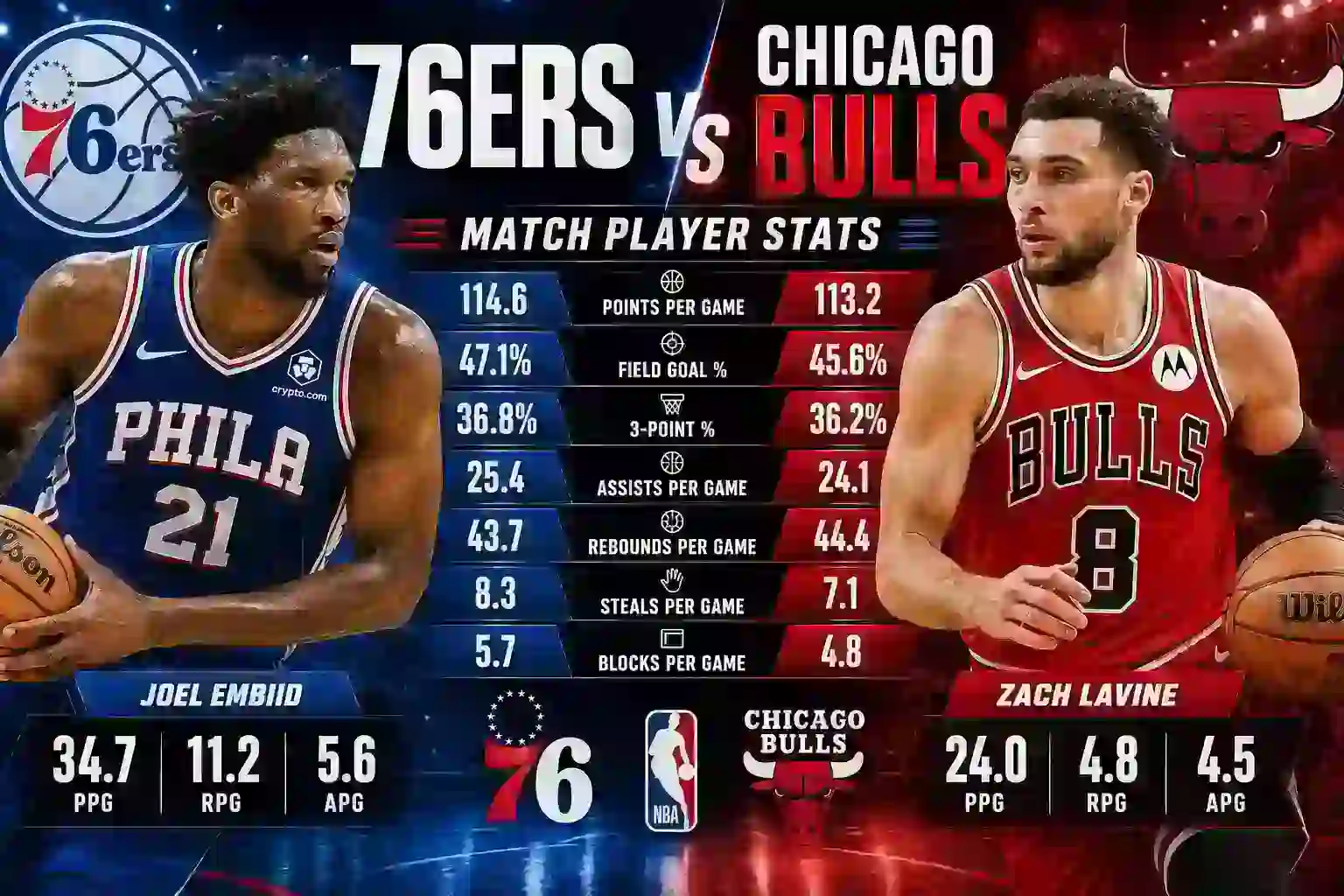
76ers vs Chicago Bulls Match Player Stats: Embiid and George Return to Torch Chicago in 157-137 Rout
Two stars came back from long absences on the same night, and the Chicago Bulls had no answer for either of them. If you’re searching for the full 76ers vs Chicago Bulls match player stats from their March 25, 2026 meeting, the short version is this: Philadelphia’s top-heavy roster clicked at exactly the right moment, and Chicago’s defense simply had no plan for it.
The Lead
The Philadelphia 76ers hosted the Chicago Bulls on Wednesday, March 25, 2026, at Xfinity Mobile Arena in Philadelphia in front of 18,921 fans. Philadelphia controlled the game from the opening tip and pulled away in the third quarter, finishing with a 157-137 win that pushed their record to 40-33 while dropping the Bulls to 29-43.
Joel Embiid, playing his first game back after missing 13 contests with a strained right oblique, needed almost no time to find his rhythm — he drilled all three of his first-half three-point attempts and had 23 points by halftime. Paul George, returning from a 25-game suspension tied to the NBA’s drug policy, started cold but caught fire after the break, scoring 23 of his 28 points in the second half. Chicago got a strong all-around effort from Josh Giddey, who posted 23 points, 9 rebounds, and 12 assists, but the Bulls couldn’t slow Philadelphia’s three-point shooting or contain their bench scoring, and the 76ers led by as many as 34 points in the fourth quarter.
Match Overview Table
| Information | Match Details |
| Event | NBA Regular Season |
| Game | Chicago Bulls vs Philadelphia 76ers |
| Date | March 25, 2026 |
| Venue | Xfinity Mobile Arena, Philadelphia, PA |
| Attendance | 18,921 |
| Winner | Philadelphia 76ers |
| Final Score | 76ers 157, Bulls 137 |
| Broadcast | Regional sports networks (BONUS – Chicago market; CHSN – Philadelphia market) |
Core Match Statistics Overview
Team Stats Comparison
| Stat | Chicago Bulls | Philadelphia 76ers |
| Field Goal % | 48/98 (.490) | 57/103 (.553) |
| 3-Point % | 15/47 (.319) | 22/47 (.468) |
| Free Throw % | 26/31 (.839) | 21/28 (.750) |
| Total Rebounds | 48 | 45 |
| Assists | 30 | 34 |
| Turnovers | 14 | 8 |
| Steals | 3 | 9 |
| Blocks | 3 | 10 |
Three-Point Shooting
- Philadelphia hit 22 of 47 attempts from deep (46.8%), nearly 15 points better than Chicago’s 31.9% clip on the same volume of attempts.
- Paul George alone drained 6 of 13 threes, while Cameron Payne added 5 of 8 off the bench — the Bulls had no single shooter who matched that efficiency.
Turnover Battle and Ball Security
- Philadelphia’s 76ers vs Chicago Bulls turnover margin was decisive: the 76ers committed just 8 turnovers to Chicago’s 14, limiting Chicago’s transition opportunities.
- The 76ers also generated 9 steals compared to Chicago’s 3, repeatedly turning Bulls mistakes into easy buckets in space.
Rim Protection and Interior Defense
- Philadelphia blocked 10 shots as a team against Chicago’s 3, with Quentin Grimes (3 blocks) and Dominick Barlow (2 blocks) disrupting Chicago’s paint touches from the perimeter and the frontcourt alike.
- Chicago actually out-rebounded Philadelphia 48-45, led by Josh Giddey’s 9 boards, but the extra possessions didn’t translate into stops.
Period-by-Period Analysis
First Quarter: 76ers 38, Bulls 26
| Team | Q1 Score |
| Chicago Bulls | 26 |
| Philadelphia 76ers | 38 |
- Embiid set the tone immediately, going 6 of 9 from the field including 3 of 3 from three-point range for 15 first-quarter points.
- Chicago hung around early behind Josh Giddey’s playmaking but couldn’t match Philadelphia’s shooting efficiency, finishing the frame ice-cold from three at just 2 of 12.
- VJ Edgecombe chipped in 11 points off the bench rotation, giving Philadelphia scoring balance even before George found his footing.
Second Quarter: 76ers 33, Bulls 26
| Team | Q2 Score |
| Chicago Bulls | 26 |
| Philadelphia 76ers | 33 |
- Embiid kept pouring it on, scoring 8 more points to reach 23 by the break while shooting a scorching 7 of 10 for the half.
- George struggled in this stretch, going just 2 of 8 from the field, but Philadelphia’s depth — Cameron Payne, Trendon Watford, Dominick Barlow — kept the lead growing anyway.
- Philadelphia closed the half on a 71-52 run advantage, a 19-point cushion built almost entirely on 76ers vs Chicago Bulls three-point shooting disparity (10 of 20 for Philadelphia versus 6 of 26 for Chicago in the half).
Third Quarter: 76ers 51, Bulls 32
| Team | Q3 Score |
| Chicago Bulls | 32 |
| Philadelphia 76ers | 51 |
- This quarter buried Chicago. Philadelphia shot an absurd 19 of 22 from the field (86.4%) and 6 of 7 from three, turning a comfortable lead into a blowout.
- Paul George caught fire here, scoring 10 points on 4-of-4 shooting including two threes, finally finding the rhythm that had eluded him in the first half.
- By the end of the quarter, Philadelphia led 122-84, and Chicago’s bench had no answer for the 76ers’ pace.
Fourth Quarter: Bulls 53, 76ers 35
| Team | Q4 Score |
| Chicago Bulls | 53 |
| Philadelphia 76ers | 35 |
- With the outcome decided, Philadelphia’s starters sat for large stretches, and Chicago’s reserves — Leonard Miller (13 points), Rob Dillingham (10 points) — padded the scoreline against a mostly second-unit 76ers lineup.
- George still added 13 fourth-quarter points on 5-of-8 shooting before the game was fully academic.
- Philadelphia’s bench, led by Justin Edwards and Jabari Walker, closed the game out cleanly without needing to lean on their stars further.
Detailed Team Player Statistics
Philadelphia 76ers Player Statistics
Joel Embiid — 35 PTS, 6 REB, 7 AST, 1 BLK (12/17 FG, 3/3 3PT, 8/9 FT, 28:06 MIN) Embiid’s return from a 13-game absence looked like he never left, attacking from every level of the floor and pairing his usual post scoring with sharp movement shooting from deep.
Paul George — 28 PTS, 6 REB, 4 AST, 4 STL (11/22 FG, 6/13 3PT, 26:20 MIN) George needed a half to shake off rust from his 25-game layoff, but his second-half surge of 23 points on a variety of pull-ups and step-backs proved he hadn’t lost his shot-making touch.
VJ Edgecombe — 22 PTS, 6 REB, 6 AST, 1 STL (7/9 FG, 4/5 3PT, 4/5 FT, 29:36 MIN) Edgecombe was Philadelphia’s most efficient scorer on the night, connecting on nearly 80% of his shots while also setting up teammates and defending across multiple positions.
Quentin Grimes — 13 PTS, 6 REB, 5 AST, 3 STL, 3 BLK (5/10 FG, 30:59 MIN) Grimes’ stat line doesn’t scream volume scorer, but his defensive activity — three steals and three blocks — made him a disruptive two-way presence throughout.
Chicago Bulls Player Statistics
Josh Giddey — 23 PTS, 9 REB, 12 AST, 1 BLK (8/13 FG, 3/6 3PT, 4/4 FT, 32:53 MIN) Giddey was Chicago’s engine all night, flirting with a triple-double and doing everything he could to keep the Bulls competitive against a deeper Philadelphia roster.
Matas Buzelis — 18 PTS, 8 REB, 2 AST (6/15 FG, 4/10 3PT, 29:55 MIN) Buzelis provided secondary scoring but needed high volume to get there, shooting just 40% from the field on a team-high 15 attempts.
Collin Sexton — 16 PTS, 1 REB, 4 AST, 1 STL (5/9 FG, 5/6 FT, 19:15 MIN off bench) Sexton was efficient in a reserve role, using his free-throw rate and quick first step to generate points in isolation.
Tre Jones — 15 PTS, 4 REB, 7 AST (4/9 FG, 7/8 FT, 27:31 MIN) Jones ran the offense steadily and got to the free-throw line often, but his limited three-point volume capped his overall scoring impact.
Statistical Leaders Summary Table
| Category | Chicago Bulls | Philadelphia 76ers |
| Leading Scorer | Josh Giddey (23) | Joel Embiid (35) |
| Second Leading Scorer | Matas Buzelis (18) | Paul George (28) |
| Top Rebounder | Josh Giddey (9) | Quentin Grimes / Adem Bona (6 / 8) |
| Most Assists | Josh Giddey (12) | Joel Embiid (7) |
Analytical Breakdowns: Why the 76ers Won and the Bulls Lost
Why the 76ers Won
Elite Three-Point Efficiency
| Stat | Bulls | 76ers |
| 3PT Made/Attempted | 15/47 | 22/47 |
| 3PT % | .319 | .468 |
Philadelphia and Chicago attempted the exact same number of threes, but the 76ers made 7 more of them — a gap worth 21 points on equal volume.
Star Power Returning Simultaneously
Embiid and George combined for 63 points on 23-of-39 shooting, giving Philadelphia two go-to scorers who could each carry stretches of the game independently, something Chicago’s roster simply couldn’t match one-for-one.
Defensive Activity and Discipline
Philadelphia forced 14 Chicago turnovers while committing only 8 of their own, and their 10 blocked shots to Chicago’s 3 reflected a defense that contested at the rim far more effectively all night.
Why the Bulls Lost
Bench Scoring Gap in the Decisive Third Quarter
Chicago’s reserves couldn’t slow Philadelphia’s role players in the third quarter, when the 76ers shot 86.4% from the field and turned a comfortable lead into a rout.
Heavy Reliance on Giddey and Buzelis
Outside of Giddey’s near triple-double and Buzelis’s 18 points on heavy volume, Chicago’s other starters — Tre Jones aside — combined for modest production, leaving too much of the offensive burden on two players.
Historical Context and Advanced Insights
Season Series Breakdown
| Matchup | Result |
| March 25, 2026 (Philadelphia) | 76ers won 157-137 |
This was a lopsided result in a season already defined by injuries and absences for both franchises — Philadelphia was still missing All-Star Tyrese Maxey (finger tendon strain) and Kelly Oubre Jr. (elbow strain), yet still cruised behind Embiid and George.
Advanced Statistical Insights
Philadelphia’s true shooting percentage for the game sat at .681 compared to Chicago’s .614, a gap driven almost entirely by three-point accuracy rather than shot selection or pace. The 76ers’ assist rate of 59.6% also topped Chicago’s 62.5% raw assist number when adjusted for made baskets, showing that even with fewer total field goals made relative to attempts, Philadelphia’s offense moved the ball with more purpose in half-court sets. Embiid’s individual offensive rating of 152 points per 100 possessions used, paired with a 33.2% usage rate, illustrates just how efficiently he carried the offensive load in limited minutes upon his return.
Game Implications and Key Lessons
What This Means for the 76ers
- A healthy Embiid-George pairing, even briefly, shows Philadelphia’s ceiling when both stars are available together.
- The win keeps Philadelphia in playoff position with Maxey and Oubre still working their way back.
What This Means for the Bulls
- Chicago’s perimeter defense needs addressing — allowing 46.8% shooting from three is not sustainable against playoff-caliber opponents.
- The Bulls will need more consistent scoring beyond Giddey and Buzelis if they hope to stay competitive down the stretch.
Key Lessons
- Efficient three-point shooting can outweigh a rebounding disadvantage.
- Turnovers and steals directly translated into easy transition points in this game.
- A team’s two stars returning from absence simultaneously can produce an immediate chemistry boost rather than a rust-related letdown.
- Bench scoring depth matters most in the third quarter, where this game was effectively decided.
- Shot-blocking and interior deterrence can offset a rebounding deficit.
- Balanced scoring beats a two-man show when the supporting cast is thin.
Frequently Asked Questions
Who won the 76ers vs Chicago Bulls game on March 25, 2026?
The Philadelphia 76ers won 157-137 over the Chicago Bulls.
Who led all scorers in the game?
With 35 points on 12-of-17 shooting, including 3-of-3 from three-point range, Joel Embiid led all scorers.
What were Paul George’s stats in his return game?
Paul George scored 28 points on 11-of-22 shooting, including 6-of-13 from three, along with 6 rebounds, 4 assists, and 4 steals.
What were Josh Giddey’s stats for the Bulls?
Josh Giddey posted 23 points, 9 rebounds, and 12 assists, falling just short of a triple-double.
How many three-pointers did each team make?
Philadelphia made 22 of 47 three-point attempts (46.8%), while Chicago made 15 of 47 (31.9%).
Where was the game played and what was the attendance?
The game was played at Xfinity Mobile Arena in Philadelphia in front of 18,921 fans.
Conclusion
Philadelphia’s win over Chicago on March 25, 2026 came down to shot-making and depth rather than dominance in any single statistical category. The Bulls actually won the rebounding battle, but Philadelphia’s three-point efficiency, ball security, and rim protection off the bench proved decisive. Embiid and George returning on the same night and immediately producing at a high level gave the 76ers a two-star advantage that Chicago’s more balanced, but shallower, roster couldn’t overcome.