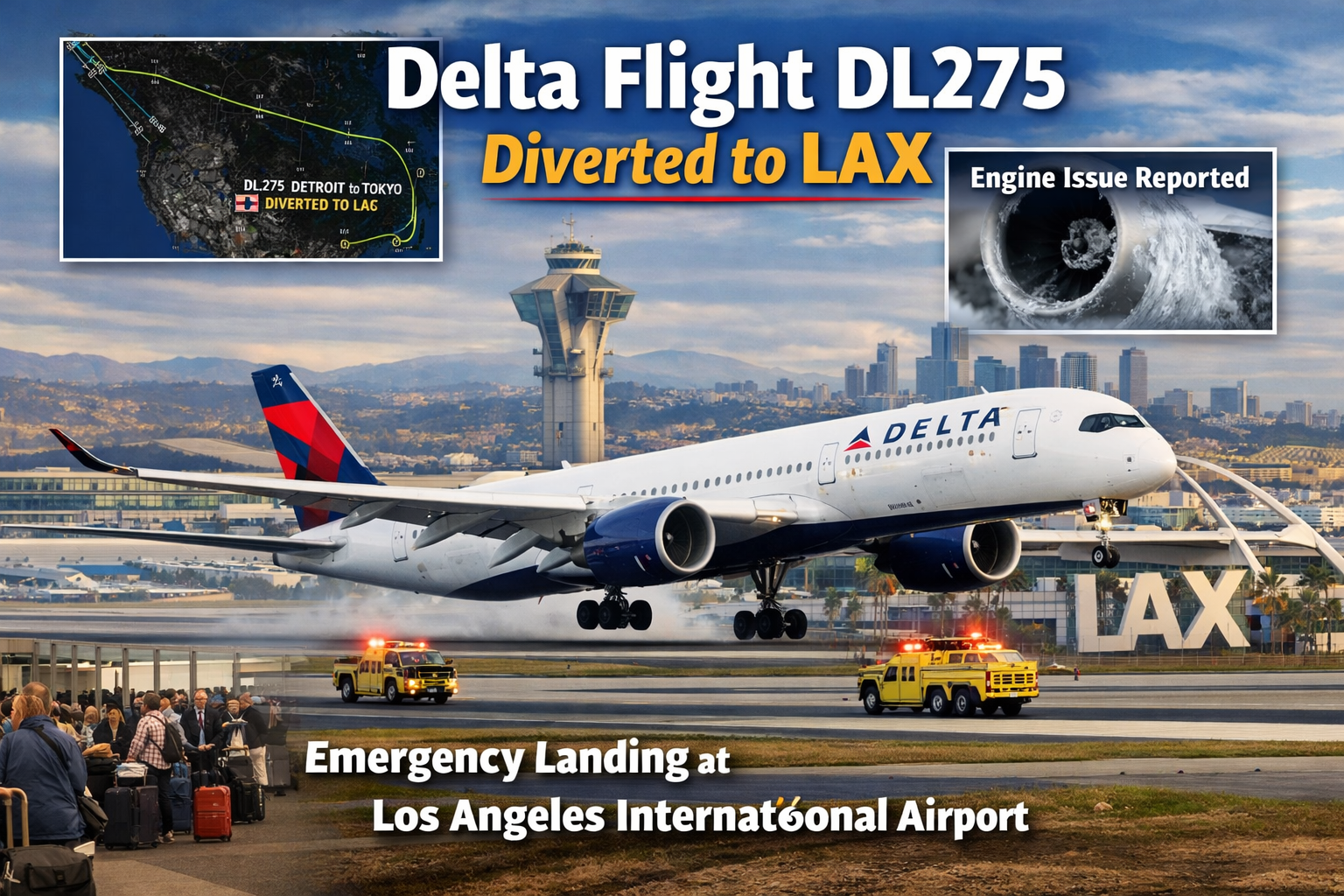
Delta Flight DL275 Diverted to LAX
Delta Flight DL275 Diverted to LAX — that headline grabbed attention fast. It sounded dramatic. It also sounded scary. But in aviation, a diversion is often a smart, calm safety move. This flight was operating from Detroit to Tokyo Haneda when the crew changed course and headed to Los Angeles instead. Reports later pointed to a problem linked to the engine anti-ice system, and the jet landed safely on Runway 06R at LAX. Passengers were rebooked, and the remainder of the trip was canceled, which is frustrating, but it’s also a sign the airline chose caution over convenience.
In this guide, you’ll get the full story in simple words. You’ll also see what’s known, what’s not confirmed, and why safety teams plan for events like this. We’ll walk through the route, the timing, and the decision to divert so far south. You’ll learn why LAX made sense for an Airbus A350, and what passengers can reasonably expect after a long-haul diversion. This is the kind of real-world aviation moment that teaches how safety works in practice, not just on paper.
Quick Answer: What happened on DL275?
Delta Flight DL275 diverted to LAX after the crew decided to reroute during the transpacific leg from Detroit to Tokyo Haneda in late May 2025. Incident reporting describes the aircraft as an Airbus A350-900 (registration N508DN) and notes passenger reports of an engine (Trent XWB) anti-ice system problem. The flight landed safely on the Los Angeles runway 06R; the onward segment was canceled, and travelers were rebooked.
Delta Flight DL275 “Biography” Table (Timeline at a glance)
| Timeline Step | What Happened | Why It Matters |
| Departure | DL275 departed Detroit for Tokyo Haneda | Normal long-haul transpacific route |
| En route over North Pacific | Crew decided to divert while cruising | Early decision-making reduces risk |
| Diversion chosen | Turned toward Los Angeles | Big hub, long runways, strong support |
| Landing | Landed safely on Runway 06R at LAX | Safe outcome is the main point |
| After landing | Remainder canceled; passengers rebooked | Common airline response after tech events |
| Aircraft status | Aircraft later returned to service | Suggests issue was addressed before reuse |
Delta Flight DL275 “Profile” Table (Fast facts)
| Field | Details |
| Focus keyword | Delta Flight DL275 Diverted to LAX |
| Flight number | DL-275 |
| Route (scheduled) | Detroit (DTW) → Tokyo Haneda (HND) |
| Diversion airport | Los Angeles International Airport (LAX) |
| Aircraft type | Airbus A350-900 |
| Registration (reported) | N508DN |
| Reported trigger | Passenger reports: engine anti-ice system issue |
| Outcome | Landed safely; remainder canceled; rebooked |
Delta Flight DL275 Diverted to LAX: the moment it became “news.”
When Delta Flight DL275 diverted to LAX, it quickly became a tracked event online. People saw the flight path change and started asking questions. That’s normal now. Flight tracking is public, and reroutes stand out. But a change in direction does not automatically mean disaster. It often means the crew noticed something early and chose a safer plan. In this case, incident reporting describes the aircraft diverting while it was cruising and then landing safely at LAX. That safe landing is the key detail most headlines bury.
Another reason the story grew is the scale of the flight. Detroit to Tokyo is long. The aircraft is large. And the route goes over remote ocean areas. When a widebody turns around, it looks dramatic on a map. Yet pilots train for this exact situation. Airlines also plan for it. Diversions are part of the safety system, not a failure of it. And in May 2025, the reports around this diversion show a decision that ended with a controlled landing and a managed passenger rebooking process.
The May 2025 incident: what is actually known
People searched for the Delta flight DL275, which was diverted to LAX in May 2025, because they wanted a clear cause. Here’s what can be stated without guessing. Incident reporting lists the flight as DL-275, operating Detroit to Tokyo Haneda, using an Airbus A350-900 with registration N508DN. It also states the crew chose to divert and landed safely on runway 06R in Los Angeles. After landing, the remainder of the flight was canceled, and passengers were rebooked. Those are concrete points that describe the event clearly.
Now the part that gets messy is the “why.” In this incident entry, passengers reported that the crew announced an issue with the engine anti-ice system. That is a meaningful clue, but it is still framed as passenger reporting, not a full technical bulletin. So the best approach is honest: we can discuss what an anti-ice issue means, and why crews treat it seriously, without claiming an official root cause that hasn’t been publicly detailed in the same way a final maintenance report would be.
Delta Flight DL275 diverted to LAX incident: why LAX made sense.
A common question is simple: why not land closer? Alaska. Seattle. Vancouver. Those sound nearer on a globe. But route planning is not just “nearest airport.” It is also runway length, available maintenance, spare parts, crew support, and the airline’s ability to care for hundreds of passengers. For an Airbus A350, a major international hub with long runways and deep resources is a strong option. LAX offers that kind of infrastructure, which helps explain the choice in a practical way.
Also, big airports handle big planes smoothly. They have towing capacity, emergency response, widebody gates, and large operations teams. If a crew is dealing with a systems concern, they may favor a destination that reduces “unknowns” after landing. That does not prove severity. It shows a preference for control. So when people talk about the Delta flight DL275 diverted to LAX incident, it helps to frame it as “risk management.” The flight ended safely, and that outcome is the clearest proof that the plan worked.
What an engine anti-ice issue means in plain English
When you hear “engine anti-ice,” think of cold, moisture, and airflow. At high altitude, ice can form in areas where it should not. Anti-ice systems help prevent that. If there is a fault, pilots do not “wait and see.” They follow procedures. They check conditions. They consider route weather and altitude options. They consider where they can land with the best support. That is why an anti-ice-related report can lead to a diversion even if everything still feels normal inside the cabin.
It is also important to separate “system problem” from “engine failure.” A system fault can be serious, but it is not the same as losing an engine. Headlines can blur that line. The incident reporting around this flight says passengers reported an announced problem with the engine anti-ice system. That wording matters. It suggests a technical concern that triggered a conservative decision, not an uncontrolled crisis. The outcome supports that reading: the aircraft landed safely, and the situation was handled in an organized way.
The human side: what passengers usually feel during a diversion
When Delta Flight DL275 diverted to LAX, passengers likely felt confusion first. Then worry. Then impatience. That emotional arc is normal. Most people do not get real-time technical detail. Crews share what they can, but they also avoid speculation. A calm cabin can still hold anxious minds. People start texting family. They refresh flight trackers. They read comments from strangers. That can raise stress fast, even when the aircraft is stable and the crew is fully in control.
After landing, the stress often shifts into logistics. Where do I sleep? How do I rebook? Do I miss a connection? Will my bags follow me? That’s when airline staff matters most. The incident reporting indicates the remainder was canceled, and passengers were rebooked. That is not fun. But it is a standard safety-first outcome after a technical concern on a long-haul aircraft.
Delta flight DL275 diverted to LAX: how stories spread online.
Search trends like delta flight dl275 diverted to lax news grow because flight diversions are visible. One map screenshot can travel across platforms in minutes. And once it spreads, people fill gaps with guesses. Some say “engine fire.” Others say “medical emergency.” Others say “scary smoke.” Many of those claims are not supported by the incident reporting for this event. That is why it helps to anchor the story in the most consistent, cited facts: route, aircraft, safe landing, rebooking, and the reported system issue mentioned by passengers.
It also helps to remember that aviation news has layers. There’s official airline messaging. There’s safety reporting. There are social posts. And there’s pure rumor. When you read about Delta Flight DL275 Diverted to LAX, aim for sources that state time, location, runway, and aircraft details, not just feelings. The more specific a report is, the easier it is to trust. In this case, the incident entry provides concrete fields like registration, route, and runway, which are strong anchors.
Why long-haul flights divert “far,” even when it looks odd
Transpacific flights are planned like chess, not checkers. Crews consider the weather. They consider alternatives. They consider fuel. They consider medical support. They consider maintenance capability. If the aircraft is heavy and full of fuel, the best landing choice may be a place with long runways and strong support services. That can push the diversion toward major hubs. It can also reduce time stuck on the ground later, because repairs and rebooking options are stronger at big airports.
This is where the phrase delta flight dl275 diverted to lax incident can be misleading. “Incident” sounds like chaos. But the decision-making can be structured and calm. The aircraft landed safely, and the rest of the flight was canceled. That reads like a controlled safety response, not a panic response. A diversion can be inconvenient for travelers, but it is often the safest and smartest call for the operation.
The aircraft factor: why the Airbus A350 matters here
Delta Flight DL275 Diverted to LAX on an Airbus A350-900, which is built for long-range routes. That matters because the aircraft has complex systems designed for efficiency and safety across long ocean crossings. When one system shows a fault, the aircraft may still fly safely, but the crew’s job is to keep margins high. That’s why a “systems” issue can produce a diversion even if the plane still handles well. The point is not “can we keep going?” The point is “what is the safest plan with the most support?”
The incident reporting also notes the aircraft registration (N508DN) and that it returned to service later. That detail is helpful because it suggests the aircraft did not remain grounded for days. It likely received checks and maintenance action before flying again. That’s the normal sequence: land, inspect, fix, verify, and then return to service. For passengers, it doesn’t remove the pain of disruption. But it does support the idea that the event was managed within standard aviation safety processes.
What “landed safely” really means in aviation terms
“Landed safely” can sound like a throwaway line. It is not. A safe landing means the flight ended without injury and without an uncontrolled event. It means the crew executed procedures. It means air traffic control supported the plan. It means the airport was prepared to receive the aircraft. For Delta Flight DL275 Diverted to LAX, incident reporting explicitly states the aircraft landed safely on runway 06R in Los Angeles. That is the most important outcome in the entire story.
It also shows how aviation safety is built in layers. Pilots do not “wing it.” They rely on checklists and training. Maintenance teams do not “guess.” They inspect and test. Dispatch teams do not “hope.” They plan routes with alternates and contingency fuel. A diversion is one visible result of that layered system. And while it creates delays and missed plans, it can be the exact action that keeps a situation from becoming dangerous later. Safety is often quiet, boring, and effective.
Passenger rights and practical steps after a diversion (USA-focused)
If you’re on a flight like this, focus on the basics first. Confirm your new booking. Ask for written rebooking details at the desk or in the app. Keep receipts for essentials if you’re stranded overnight. Then ask the airline what support they are offering. Policies vary by cause and by situation, but clear documentation helps every time. Take screenshots of rebooking notices, hotel offers, and any vouchers. Keep your boarding pass and tags until your trip is fully done.
Also, protect your energy. Long disruptions can make people snap. Be kind to staff. They are juggling many travelers at once. If your bags were checked, ask what the plan is for routing them to your final destination. In events where Delta Flight DL275 was diverted to LAX, passengers were rebooked, which usually means baggage systems are also rerouted, but delays can happen. The best tool you have is calm follow-up and clear records.
Common myths people believe about diversions
Myth one: “A diversion means the plane was about to crash.” Not true. Many diversions happen out of caution. Myth two: “If they divert, the plane is broken beyond repair.” Not true. Many issues are fixable quickly. Myth three: “Pilots hide the truth.” In reality, pilots share what they can safely and responsibly share, but they also avoid guessing before maintenance confirms details. That protects passengers from confusion and fear.
For this event, the clearest technical clue is the passenger-reported announcement about an engine anti-ice system problem. That does not automatically mean catastrophic engine damage. It means a system concern was taken seriously enough to change plans. And it ended with a safe landing and passenger rebooking. If you want to talk about Delta flight DL275 diverted to LAX news in a smart way, keep the story anchored in confirmed outcomes, not viral panic language.
Why do airlines sometimes cancel the rest of the flight after landing
After Delta Flight DL275 was diverted to LAX, the remainder was canceled, and passengers were rebooked. That can happen for several practical reasons. First, maintenance must inspect and clear the aircraft before it can fly again. Second, crews have duty-time limits. If the diversion extends time on duty, a new crew may be needed. Third, the airline must find a slot and gate availability. Fourth, international arrival logistics at the destination can change with delays.
Canceling the remainder is not always “bad service.” Sometimes it is the safest and most realistic choice. People often forget that a long-haul flight is a complex chain. A diversion breaks that chain. Then, operations have to rebuild it in real time. That usually means rebooking passengers across multiple flights. It’s annoying, but it can also be the fastest way to move hundreds of people when one aircraft cannot continue on its original timeline. That is why rebooking is a normal response after a significant technical event.
What this story teaches about aviation safety culture
This event shows a simple truth: safety wins over schedules. When a crew sees a technical warning, they treat it seriously. They do not try to “push through” just to arrive on time. That is the culture aviation has built over decades. It is also why flying remains extremely structured and procedure-driven. The goal is not bravery. The goal is predictability. A diversion is often the most predictable way to reduce risk.
So when people ask about the Delta flight DL275 diverted to LAX incident, the most helpful framing is this: a problem was suspected, the crew selected a strong alternate, and the aircraft landed safely. Then the airline handled passengers through rebooking. Those steps reflect a system doing what it is designed to do: detect, decide, mitigate, and recover. That is not a fun travel day, but it is a strong safety story.
LSI / semantic keywords that fit this topic naturally
When writing about Delta Flight DL275 Diverted to LAX, you’ll see related phrases come up often. These include: “flight diversion,” “precautionary landing,” “aircraft systems alert,” “long-haul widebody,” “transpacific route,” “airline rebooking,” “crew duty time,” “maintenance inspection,” “alternate airport,” and “runway availability.” These terms help readers understand the real-world mechanics behind a headline.
They also help you avoid repeating the same phrase in every sentence. Readers get bored fast when a page sounds like a loop. Instead, a strong article explains the same idea using different simple words. That is how you keep clarity high while still covering all the questions people ask. And in this case, the questions are very human: What happened? Was it dangerous? Why LAX? What do passengers do next?
The big takeaway from May 2025
Let’s bring it back to what matters most. Delta Flight DL275 was diverted to LAX and landed safely. The flight was scheduled from Detroit to Tokyo Haneda. Incident reporting describes a decision to divert and includes passenger reports of an engine anti-ice system issue. The remainder of the flight was canceled, and passengers were rebooked. Those facts paint a picture of caution and control, not chaos.
If you are a traveler, the lesson is simple. A diversion can be stressful, but it is usually a safe choice made early. If you are reading as an aviation fan, the lesson is deeper. This is how modern aviation manages risk in real time. It detects a possible problem, chooses a high-support airport, and prioritizes a safe landing over a perfect schedule. That’s the system working as intended.
FAQs
1) Why did Delta Flight DL275 divert to LAX?
Incident reporting notes passengers said the crew announced a problem tied to the engine anti-ice system. The aircraft then diverted and landed safely at LAX.
2) Is there an official cause confirmed publicly?
Public incident summaries describe the event and include passenger-reported details, but they do not read like a full public maintenance report. It’s safest to stick to the documented summary and outcomes.
3) When did the delta flight dl275 diverted to lax may 2025 event happen?
The incident entry lists the date of the incident as May 26, 2025, for DL-275 on the Detroit–Tokyo Haneda route.
4) Why was LAX chosen instead of a closer airport?
Diversion choices depend on support, runway length, widebody handling, maintenance capability, and passenger care resources. Major hubs like LAX can be a strong option for an A350 event.
5) Did the plane land safely?
Yes. Incident reporting states the aircraft landed safely on the Los Angeles runway 06R.
6) What happened to passengers after landing?
The incident summary says the remainder of the flight was canceled and passengers were rebooked onto other flights.
Conclusion
When Delta Flight DL275 diverted to LAX, it created anxiety, questions, and a lot of online chatter. But the most important facts stay steady. The flight diverted, landed safely at LAX, and passengers were rebooked. The reported trigger involved a system concern tied to engine anti-ice. That’s exactly the kind of issue pilots are trained to treat with care.
About the Author