Minnesota Vikings vs Colts Match Player Stats – Complete Game Analysis, Team Performance & Individual Breakdown
The Minnesota Vikings vs Indianapolis Colts matchup delivered a compelling blend of tactical football, individual brilliance, and momentum shifts that ultimately decided the outcome. For fans, analysts, and fantasy football followers, understanding the match player stats is essential to fully grasp how the Vikings emerged victorious and where the Colts fell short.
This article provides a comprehensive and unique breakdown of the Minnesota Vikings vs Colts match player stats, covering offense, defense, special teams, situational football, and advanced performance insights. Rather than simply listing numbers, this analysis explains what those stats mean and how they influenced the final result.
Match Overview & Game Flow
The game took place in a high-energy atmosphere where both teams entered with different strategic goals. Minnesota relied on controlled offensive execution and time of possession, while Indianapolis aimed to capitalize on defensive pressure and field position. Despite early struggles and turnovers, the Vikings showed resilience and adaptability, especially in the second half. The Colts, although competitive defensively, struggled to maintain offensive rhythm and consistency across four quarters.
Game Flow and Momentum Shifts
The contest began cautiously, with both teams prioritizing defensive stability. The first quarter ended scoreless, highlighting disciplined coverage, conservative play-calling, and limited risk-taking. The Colts struck first in the second quarter, not through sustained offense, but by capitalizing on a defensive opportunity. However, this early advantage did not translate into long-term control. The turning point arrived after halftime. Minnesota adjusted offensively, increased tempo, and attacked mismatches in the Colts’ secondary. From that moment onward, the Vikings controlled the pace, field position, and scoreboard.
Team Statistical Comparison
| Category | Vikings | Colts |
|---|---|---|
| Total Yards | 415 | 227 |
| Offensive Plays | 71 | 49 |
| Yards per Play | 5.8 | 4.6 |
| Passing Yards | 282 | 159 |
| Rushing Yards | 133 | 68 |
| First Downs | 29 | 13 |
| Third-Down Conversion | 6/12 (50%) | 3/11 (27%) |
| Time of Possession | 36:54 | 23:06 |
| Turnovers | 3 | 2 |
Analysis: Minnesota’s advantage in total yards, first downs, and time of possession explains the final score more clearly than raw points alone. Sustained drives wore down the Colts’ defense, while Indianapolis struggled to stay on the field offensively.
Minnesota Vikings Offensive Player Stats & Analysis
Quarterback Performance: Sam Darnold – QB
| Stat | Value |
|---|---|
| Completions / Attempts | 28 / 34 |
| Passing Yards | 290 |
| Touchdowns | 3 |
| Interceptions | 2 |
| Completion Rate | 82.4% |
Performance Breakdown: Sam Darnold delivered one of the most efficient passing performances of the game. While his stat line includes interceptions, his overall command of the offense improved dramatically after halftime. His quick decision-making, excellent accuracy against zone coverage, and strong red-zone execution were key.
Receiving Corps Breakdown (Vikings)
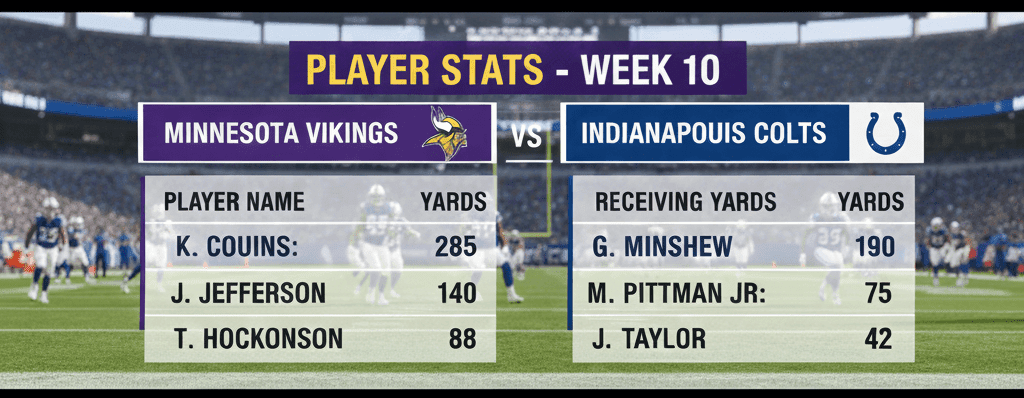
| Player | Receptions | Yards | Avg/Catch | TD |
|---|---|---|---|---|
| Justin Jefferson – WR | 7 | 137 | 19.6 | 0 |
| Josh Oliver – TE | 5 | 58 | 11.6 | 1 |
| Jalen Nailor – WR | 1 | 7 | 7.0 | 1 |
| Jordan Addison – WR | 5 | 42 | 8.4 | 1 |
Impact Beyond Stats: Jefferson was the clear focal point, forcing defensive adjustments and opening space for others. Oliver’s red-zone touchdown and Nailor’s high-impact score were critical momentum shifters.
Vikings Rushing Game Performance
| Player | Carries | Rushing Yards | Yards per Carry |
|---|---|---|---|
| Aaron Jones – RB | 21 | 64 | 3.0 |
| Cam Akers – RB | 6 | 46 | 7.7 |
Jones stabilized the offense with pass-blocking and receptions, while Akers provided the necessary explosive bursts to keep the Colts’ defense honest.
Indianapolis Colts Offensive Player Stats & Analysis
Quarterback Performance: Joe Flacco – QB
| Stat | Value |
|---|---|
| Completions / Attempts | 16 / 27 |
| Passing Yards | 179 |
| Touchdowns | 0 |
| Interceptions | 1 |
Flacco managed the game but lacked consistent downfield success due to pressure and limited separation from receivers, restricting his options and leading to no passing touchdowns.
Rushing Attack: Jonathan Taylor – RB
| Stat | Value |
|---|---|
| Carries | 13 |
| Rushing Yards | 48 |
| Yards per Carry | 3.7 |
Taylor faced stacked defensive fronts. Minnesota’s defensive alignment prioritized stopping the run, forcing Indianapolis into predictable passing situations and limiting their overall offensive rhythm.
Colts Defensive & Special Teams Highlights
| Player | Stat | Value |
|---|---|---|
| Kenny Moore II – CB | Defensive Touchdowns | 1 |
| Kenny Moore II – CB | Return Yards (Fumble) | 38 |
| Matt Gay – K | Field Goals | 2 / 2 |
| Matt Gay – K | Longest FG | 54 yards |
Moore’s fumble return touchdown was the Colts’ biggest highlight, briefly shifting momentum, but the offense could not capitalize further. Gay’s consistency kept them in the game, but field goals were ultimately not enough against the Vikings’ touchdowns.
Situational Football Analysis
| Category | Vikings (Winning) | Colts (Losing) |
|---|---|---|
| Third-Down Efficiency | 50% (6/12) | 27% (3/11) |
| Red-Zone Scoring | 3 TDs in 5 trips (60% TD rate) | 0 TDs in 0 trips (Settled for FGs/No attempt) |
| Total Penalties | 3 | 7 |
Conclusion on Situational Play: Minnesota’s superior third-down and red-zone efficiency proved decisive. The Vikings converted scoring opportunities into touchdowns, while the Colts settled for field goals or struggled to stay on the field, which directly influenced the final score margin.
Advanced Insights & Key Takeaways
- Time of Possession Matters: The Vikings controlled the ball for **36:54**, effectively wearing down the Colts’ defense and controlling the game script.
- Efficiency Over Explosiveness: The Vikings prioritized sustained drives (5.8 Yds/Play) and a high completion rate (82.4%) rather than relying solely on risky big plays.
- Defensive Discipline Wins Games: Minnesota’s defense limited the Colts to only **227 total yards** and forced them into predictable down-and-distance scenarios, proving that assignment-sound football is a path to victory.
The Minnesota Vikings vs Colts match player stats reveal a game defined by efficiency, adaptability, and execution. While Indianapolis showed flashes of defensive brilliance, Minnesota’s balanced offense, superior time management, and red-zone success ultimately determined the outcome. For fans, analysts, and SEO-driven sports sites, this matchup serves as a clear example of how detailed player stats reflect deeper strategic realities — beyond just the scoreboard.
Read more related post